If you like music, and I don’t mean a specific genre, but music in general, then you should definitely check out this world-famous masterpiece. Les Choristes will take you into a deep world of musical devotion and strong emotions. If you have ever doubted that one person can change the fate of others, now is the time to believe it.
In a boarding school for unruly children, the principal Lachin (François Belleion) has established a very high-pressure system that promises to respond to any behavior, and each behavior will have a corresponding punishment.
In this context, former music professor and musician Clement Mathieu (Gérard Junior) accepts the position of principal. Nicknamed “Crane D’Oeuf” by his students, Clement Mathieu succeeds in impressing the students by injecting more justice into the school system and conveying his love for music to them. He even touches Mohange (a boy who has been abandoned by everyone). Mohange’s beautiful singing voice will be revealed in the film.
Clement Matthew has a crush on Mohange’s mother, but to his greatest disappointment, she is engaged to someone else.
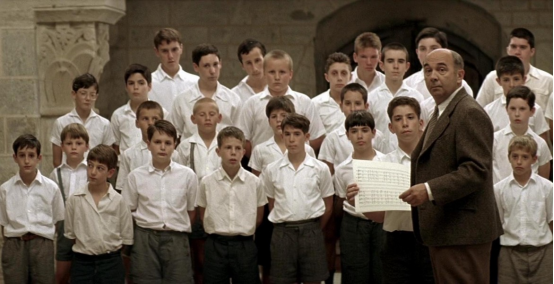
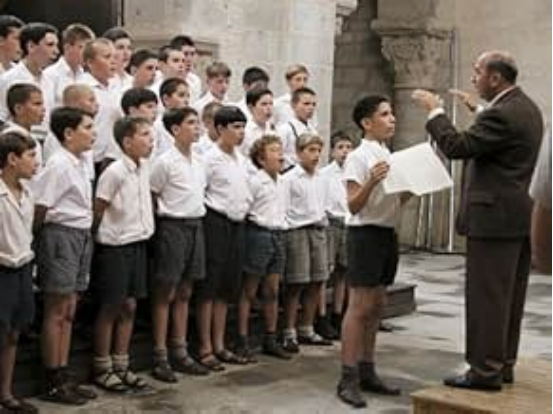
The purity of the children’s voices in Rameau’s music is breathtaking. This film is deeply moving and will take you back to your childhood (even if your childhood was different from the one depicted in the film).
The film ends on a note of hope and melancholy, with Clement Mathieu being expelled from school for a small mistake.
Years passed, his mother died, and Mohange opened Clement Mathew’s memoirs.
The whole film is filled with the positive spirit of musical revelation. Don’t miss it! The Chorus is perhaps one of the most remarkable films for its raw narrative quality. It is a film that explores the transformative power of music, and naturally invites comparisons to the only other film of its kind that most people can think of: Mr. Holland’s Opus. While not identical, they both emphasize the value of music education, and in particular the figure of the music educator. Since music educators are generally not given the slightest respect in our society, I appreciate that every twenty years some creative filmmaker has the courage to make a film that celebrates a type of educator who is disadvantaged in a profession that is inherently disadvantaged. In other words, the film has stayed in my mind based on its subject matter alone, even though I haven’t seen it once in the past decade. As I’ve said in previous reviews of French films, the name The Chorus loses something in translation; the English title “The Chorus” literally translates to “The Choristers” (meaning “school children”), but with a subtle hint of meaning. Because, ultimately, this film is about them.
The Chorus uses a fascinating dual-frame narrative. Pierre Mohanger, one of the few who has achieved great success as a classical musician, returns home to his small town in France upon learning that his mother, Violet, has died. After the funeral, a visitor arrives: Peppino, a classmate of Pierre’s at Fond de l’Etang, an oppressive boys’ boarding school. He brings a gift for Pierre from the school’s former director, Clément Mathieu. Peppino pulls out an old group photo, and Pierre gazes at it, immediately conjuring up one of my favorite passages from Roger Peyrefitte’s novel, A Peculiar Friendship:
“It’s the most beautiful thing in the world, it’s the most beautiful thing in the world, it’s the most beautiful thing in the world, it’s the most beautiful thing in the world, it’s the opposite…”
The photograph is not a gift, however. The late Clement Mathieu bequeathed to Pepino his diary from his time as a tutor at the Pond, and Pepino seems to understand that Mathieu ultimately intended to give the book to Pierre, the heir to Mathieu’s musical gift that changed his life. Pierre and Pepino are lost in a shared reverie as Pierre reads from the diary; then the narrator’s voice changes to Mathieu’s, and we enter the inner frame of the story of The Choir.
Sincere movies always hold you tightly. After more than 100 minutes of sound and color, the soul is returned to you. You can judge and praise it, but it stands aside with aloofness, watching with indifference. The roar of anger and the tears of emotion are all vented and collected by yourself in front of the screen. It seems that there is no beginning and no end. The catalyst is the movie. At this moment, I am ruminating on those more than 100 minutes. There are no beautiful actors, no fancy stunts, a few childish “problem” children, a bald teacher, and clean and simple music. The trickling story does not cause intense crying and laughing, but it can file the edges and corners gently…
When the singing begins, everything is silent, and the little touches of emotion gradually gather into a rushing river. You can’t help but sing along with them, singing the moving spring, singing the precious kindness, singing the warm hope. Every child is pure and innocent, and every bit of innocence is worth cherishing. There is an angel at the bottom of the pond.