introduction
Hayao Miyazaki’s “Spirited Away” has long been an indelible classic in the hearts of moviegoers worldwide. While seemingly a fantasy adventure for children, it often brings tears to the eyes of adults. The film not only tells the story of a little girl’s growth in a strange world, but also offers a mirror for every viewer: a chance to reflect on childhood, examine reality, and contemplate how to maintain inner purity in a world rife with materialism.
This article will attempt to interpret this work from two perspectives: one is a philosophical allegory about ideals and the instinct for goodness; the other is a gentle metaphor about childhood and farewell .
An Ordinary Kid’s Extraordinary Adventure
The story’s protagonist, Chihiro Ogino, is an ordinary ten-year-old girl: delicate, timid, and prone to tears, just like the rest of us. During a move, she and her parents stumble into a mysterious town. The streets are dilapidated and desolate, yet they conceal complex and strict rules: eating the wrong food will turn you into a pig, not working will lead to exile, and greed will bring punishment.
Chihiro’s parents, driven by gluttony, are transformed into pigs, leaving the young girl to fend for herself. To protect herself, she finds work at Yubaba’s bathhouse, gradually learning to live within the rules. Unlike many traditional fairy tales, Chihiro doesn’t attempt to subvert the order as a “hero,” but rather chooses to accept it and maintain her own identity within it. This setting lends the story a profoundly realistic perspective: each of us in society must also abide by the rules. The real difference lies in being tamed by them, or maintaining a sense of self within them.
The metaphor of a small town: an abstract portrayal of reality
The town in the film is not just a fantasy paradise, but a symbolic reflection of real society:
Material temptation : Food and money become traps for both gods and humans, revealing the desire nature of consumer society.
Identity and value : People who do not work lose their sense of existence, which symbolizes that modern society defines personal value by “productivity”.
Human alienation : In a world where monsters are the norm, humans become the “other,” suggesting a self-reflection of civilization.
Miyazaki uses this to convey a straightforward but profound fact: the fairy-tale town is just a mirror image of real society .
The Instinct for Good: The Power of a Child
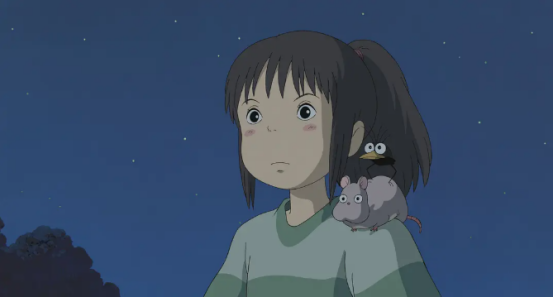
The reason why Chihiro can survive in the small town and gradually gain recognition is not because of her wisdom or strength, but because of her childlike kindness and courage.
When the filthy river god arrives at the bathhouse, everyone avoids him, but Chihiro steps forward and cleanses him until the filth is completely gone. This scene isn’t a heroic act, but simply an act of instinctive kindness. It’s this uncalculated innocence that earns her the respect of others and awakens a long-lost belief in the audience: kindness doesn’t require a reason, it only requires courage .
The Two Sides of the Rule: Yubaba and Zeniba
The most symbolic characters in the film are a pair of twin sisters: Yubaba, who runs the bathhouse, and Zeniba, the kindhearted woman who lives in the suburbs. They are like two sides of a coin, representing the fundamental laws of the world:
Equivalent Exchange : At Yubaba’s place, Chihiro loses her name in exchange for a job, implying the tug-of-war between survival and self.
Karma : Granny Zeni symbolizes moral order, reminding the audience that every choice has consequences.
Qianxun does not transcend these rules, but remains true to herself within them. Her courage is not to change the world, but to choose to maintain purity in an imperfect world.
Faceless Monster: A Projection of Humanity
The faceless monster is the film’s most enigmatic character. He has no face, no identity, yet he develops a strong attachment to Chihiro upon meeting her. This character symbolizes the universal state of human nature: the oscillation between desire and loneliness, the struggle between kindness and greed.
When the faceless monster devours frantically in the bathhouse, pouring out gold and silver like a flood, it actually depicts a scene of “desire out of control.” But in the end, he chooses to follow Chihiro, vomits out his filth, and returns to peace. This transformation seems to remind the audience: the faceless monster exists in each of us. The key is whether someone can awaken our inner desire for good .
The second story: Farewell to childhood
In addition to being a social allegory, “Spirited Away” also has another gentle metaphor: it is a ceremony about saying goodbye to childhood.
The film begins with a move. For a child, moving means parting with familiar surroundings, friends, and even past memories. Perhaps that small town is the “childhood world” Chihiro subconsciously constructs, allowing her to complete a belated farewell in her imagination.
Grandpa Boiler is like a kind grandfather;
Yubaba and Zeniba are like the two sides of grandma: strict and gentle at the same time;
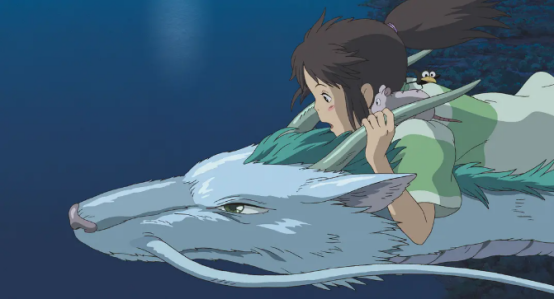
The White Dragon takes on the memory of being rescued by the Amber River in his childhood;
The faceless monster might be the silent, watching companion on campus.
Every character in the town is a reflection of her childhood. In the end, when Haku bids farewell to Chihiro and tells her not to look back, the audience understands that this is her farewell to her childhood.
The Station of Time: Growth that cannot be reversed
At the end of the film, Chihiro emerges from the tunnel and reunites with her parents. The car is piled high with fallen leaves, and her mother casually says, “It must be a prank.” In reality, it wasn’t a prank, but the traces of time.
Time is a train that moves only forward; no one can truly turn back. The small town of childhood will forever remain in the depths of memory, becoming a point of origin in everyone’s heart that can never be reached again.
Conclusion: Do you still remember that small town?
The reason why “Spirited Away” is touching is that it tells the story not about others, but about ourselves: how to remain pure under the discipline of reality, and how to retain the original intention in the farewell of growth.
When we envy Chihiro’s courage, we are actually missing the innocence we once possessed. That instinct for goodness hasn’t vanished; it’s still within us, waiting to be revived.
Perhaps, this is Miyazaki’s most gentle reminder: Don’t forget that you were once the child walking through the small town.
So here’s the question: if you had your own “childhood town,” what would it look like? Do you remember looking back when you left?