Introduction|More Than Just a Racing Movie
Rush , directed by Ron Howard in 2013 , takes a different approach. This film, adapted from real historical events, not only restores the passionate confrontation on the F1 track, but also deeply portrays the human light of two legendary drivers – Niki Lauda and James Hunt – between glory and cost. It is a direct confrontation between speed and fate, and it is also a mature biographical work about respect, growth and self-awareness .
The flames of the F1 track: audio-visual and dramatic
At the beginning of the film, accompanied by the roar of the engine, the friction of the tires and the whistling wind, the audience is almost immediately pulled into the world of soaring adrenaline. Unlike the “fast food” racing movies that only pursue sensory stimulation, the track scenes of ” Rush ” not only accurately restore the speed aesthetics of F1 racing, but also create a strong sense of presence and immersion through difficult shots such as rain battles, loss of control, and collisions.
But what really convinces people is that the story behind the speed is told deeply and truthfully . Howard and screenwriter Peter Morgan have a tacit cooperation. They successfully injected a lot of character details and psychological levels into the tense and exciting rhythm. There is no redundancy, no wasted scenes, and even an interview or a conversation contains clues to the fate of the characters.
James Hunt and Niki Lauda: A clash of souls in extreme contrast
In terms of character setting, the film creates a classic structure of “mirror confrontation”.
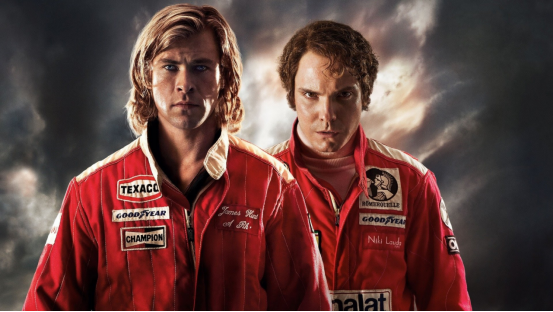
James Hunt, the 1976 F1 world champion, is sunny, flamboyant, sexy and full of charm. He is unruly, crazy and adventurous, and regards the racetrack as a burning field of life; his private life is chaotic and indulgent, but he is kind-hearted. He is a combination of speed and hormones, and a rock star on the track.
In contrast, Niki Lauda is a rational person. This three-time F1 world champion is known for his rigor, self-discipline and technical proficiency. He does not rely on talent to win, but controls every race with unremitting training and precise calculations. He is taciturn and restrained, but it is precisely because of this that he appears calm and powerful.
Since they first met in F3, they were destined to become each other’s most important rivals in their careers – and the most difficult to replicate “others”. They were tit-for-tat and unwilling to give in on the field, but gradually developed an indescribable mutual appreciation in the face of life’s challenges.
From confrontation to respect: the complex emotions between men
The most touching thing about the film is that it breaks through the “worship-eulogy” model of traditional biopics and chooses to show “heroism among enemies” . For Nicky, James is the “pusher” who forces him to constantly break through the limits and return from the fire; for James, Nicky’s tenacity makes him understand that racing is not just about speed, but also a belief and responsibility.
Especially after Nikki suffered severe burns, James was no longer just an aggressive opponent, he began to show a deep understanding of Nikki’s humanity and a hidden concern. When James privately beat up the reporter who insulted Nikki, the audience seemed to see for the first time the sincerity beneath his “playboy” appearance.
Nicky’s later classic dialogue: “Don’t regard enemies in life as a curse, they are also a gift from God.” – almost expresses the core theme of the entire movie: opponents shape you and even make you.
Performance and restoration: the ultimate confrontation between the two male protagonists
The “double hero” combination of Chris Hemsworth and Daniel Bruhl is undoubtedly the key to the success of the film. The former abandoned the stereotyped image of “Thor” as a brave and upright person and played the complexity of James Hunt: he can be confident and arrogant on the court, but vomit before the game due to anxiety the next second. He squanders his life, but he is not ruthless; he does not follow the rules, but he is never shameless.
Daniel Brühl completely “incarnates” Niki Lauda – from his demeanor, tone of voice to his inner drama of rationality and pain, he plays a misunderstood cold-faced champion in a credible way. During his post-race recovery, the scene of him watching the race while receiving painful treatment was moving and even heart-wrenching.
It is worth mentioning that the two actors are not only similar in appearance, but also in spirit. The real-life image comparison at the end of the film is undoubtedly the greatest affirmation of their performances.
The Fusion of Reality and Dreams: The Emotional Background of Rush
Although it is a biographical film, Rush is like a poetic biography of heroes. It tells history and films dreams. It uses real events as its framework, but gives it the emotional warmth and philosophical depth that are unique to film art.
It shows us such a relationship in life: you think you are fighting, but you are actually walking together; you think you are competing, but you are actually illuminating each other . This kind of “love of understanding” between heroes is much deeper than love.
In conclusion|It is worth it for everyone who loves life and challenges
This work has won great reputation among fans. It not only touched F1 fans, but also touched all those who love the truth and complexity of human nature.
Whether you prefer the audio-visual feast of high-speed competition, or are obsessed with stories about psychological tension and character growth, ” Rush ” is worth watching again and again.