If you know anything about movies, you’ve no doubt heard of The King’s Speech – it’s one of the favorites to be nominated for Best Picture at the upcoming Academy Awards. It’s a well-made film that tells a story about British history that Americans don’t know much about.
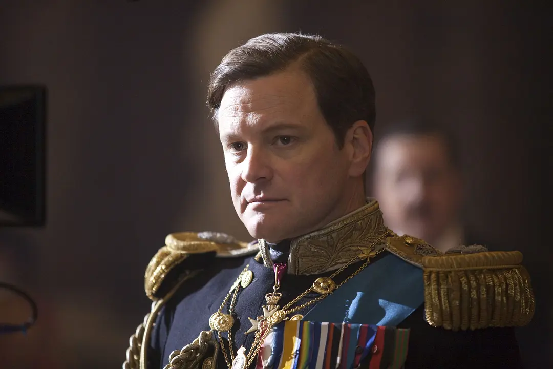
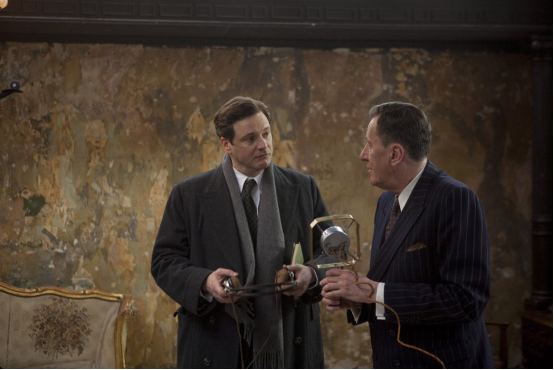
The King’s Speech tells the story of King George VI (Colin Firth), a monarch who never expected to take the throne. Born “Prince Albert, Duke of York,” he suffers from a severe stutter that greatly affects his ability to speak in public. (Several painful scenes early in the film showcase his struggle with the stutter.) After Albert repeatedly tries conventional methods and fails to overcome his stutter, his devoted wife Elizabeth (Helena Bonham Carter) eventually seeks the help of psychotherapist Lionel Logue (Geoffrey Rush). Though progress is slow, Albert eventually makes progress, though he is thrust into premature trials. As World War II approaches, he becomes the focus of public attention.
The premise is simple, and director Tom Hooper handles it deftly. Albert’s slow, arduous journey is fascinating and thought-provoking. His initially confrontational relationship with Lionel eventually develops into a deep friendship, which serves as his anchor during the dark days of the early years of World War II.
The performances in the film are first-rate and are almost the key to the film’s huge critical and box office success. Firth, Bonham Carter and Rush break the limitations of their roles and show strong characters that are completely different from their previous roles. Albert is not the rugged and confident Mr. Darcy, but a leader with inner conflicts, high morals and lack of confidence; Elizabeth is not a weird character written by Tim Burton, but a gentle, thoughtful wife and mother who loves her husband deeply; Lionel is far from being a villainous character. He is a witty, humorous and compassionate partner who helps Albert reach his full potential. The three protagonists are the emotional core of the film and their performances are impeccable.
However, I personally felt that the film lacked a certain resonance. Perhaps it was because it was widely touted as one of the best films of 2010-2011 that it was difficult for other films to compare to it. For my part, I wish the tone of the film was a little warmer. The film is handled very historically and calmly, with less focus on Albert as a person (rather than just King Albert). If Albert and Elizabeth had more exclusive scenes together, it would have helped to build the necessary chemistry, especially seeing how Albert’s stuttering affected their relationship. Although they loved each other deeply, I wish their interactions were stronger.
The use of vulgar language in the film has been widely discussed. Nonetheless, in context, the vulgar language is handled appropriately – Lionel notices that Albert does not stutter when he says curse words, and uses this discovery to help him with his therapy. This may be a controversial point, but I agree with Roger Ebert that the film should not have been rated R. There is no other objectionable content in the film, and the use of vulgar language is of great historical and artistic significance. As Colin Firth said, “These forbidden words become temporary tools to free a person from extreme repression… It doesn’t teach your children to intersperse these words in their speech, or to use them against others.” In this particular context, a PG-13 rating would have been more appropriate.
All in all, this is a film for British culture lovers and anyone who loves British history. It tells a moving story about how a man overcame his own weaknesses to lead his country out of a difficult situation. Highly recommended! It’s a beautiful film, a work of art.
The King’s Speech does not rely on visual effects, beauties, or fancy clothes, nor does it require you to keep your eyes fixed throughout the film. It is not the kind of film that violently triggers the audience’s hormones, but blooms quietly, like a night-blooming cereus. Although there is no climax, every moment is a climax, like the elegance in slow motion. The film relies on strong tension, especially through the superb performances and editing of the actors, to bring unparalleled emotional tension to the audience.
Colin Firth’s performance in the film is undoubtedly at the master level. He makes a stuttering king present a dual temperament of pity and respect. His plain speech scene becomes full of tension through delicate emotional turns. But the success of the film is not only due to Firth. Other actors, such as Jeffery Rush, Helena Bonham-Carter, Guy Pearce, etc., also bring essential tension to the film. They provide Firth with a stage to fully display his acting skills, making every scene in the film unforgettable.
The film’s editing and rhythm also support this emotional tension. In particular, George VI’s declaration of war speech at the end of the film is very moving. With the accompaniment of Beethoven’s Seventh Symphony, the camera gradually unfolds, showing the British people’s temperament of calmly coping with difficulties, showing the country’s determination and courage. The tranquility and climax at the end are intertwined, which makes people stand up and applaud.
Although British films tend to be delicate and not grand, when a film finds a balance between performance and narrative rhythm, it becomes a work of art. The King’s Speech is such a film that is both tense and beautiful, and it is worth watching again and again.
Although this movie is excellent, it is still a long way from being the best in my personal opinion. It is completely worthy of being a good movie , but it still fails to reach the top.